
What Sakai’s Reported Serve Speed Actually Proves
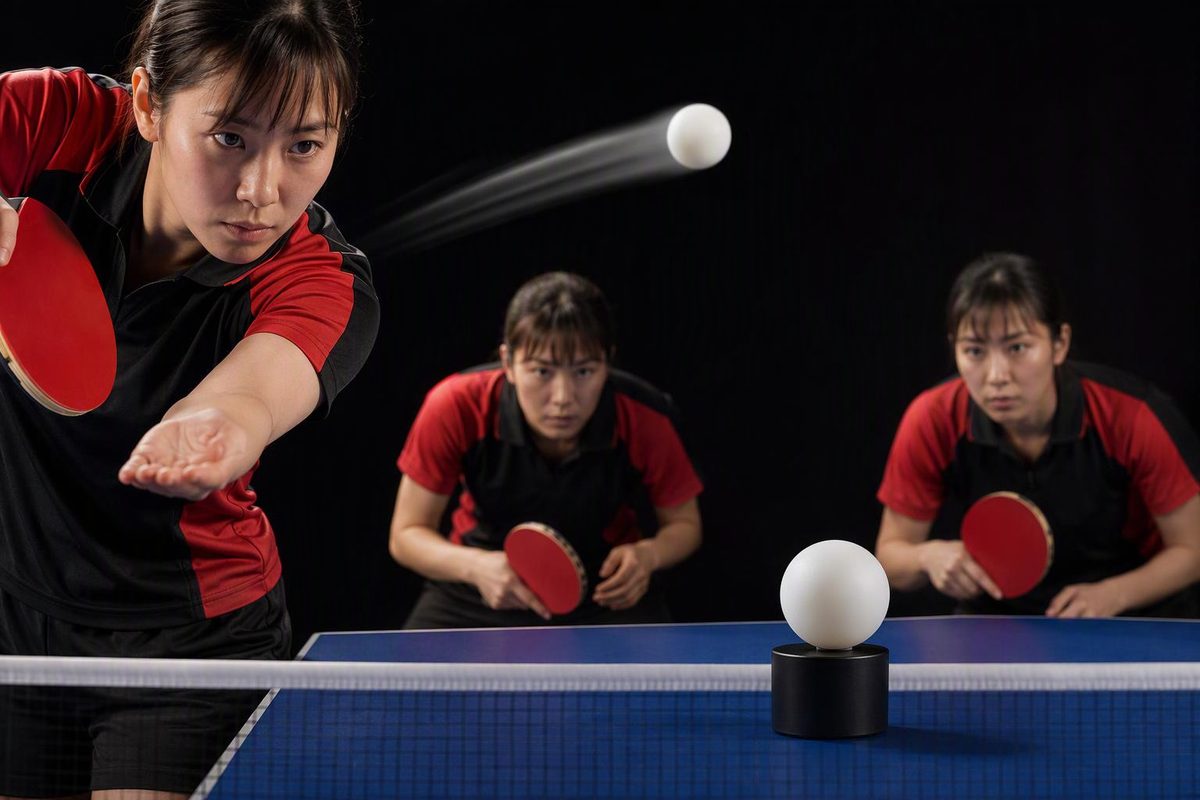
Compare Asuka Sakai’s reported 54 km/h serve with viral match clips and a Guinness ball-speed record, and see what the evidence does—and does not—prove.
Asuka Sakai’s serve is reported at approximately 54 km/h—15 metres per second, or 33.6 mph—but the cited evidence does not establish it as the current official fastest recorded serve in table tennis. PingSunday attributes the calculation to footage captured by TT Edge. It presents a published speed estimate, not a record certificate or a documented radar test.
The defensible answer is therefore Sakai’s reported estimate, with that qualification attached. A spectacular serve, a measured serve and a ratified record are different claims. Neither a viral match clip without a speed measurement nor a cannon-launched ball record resolves the question of the fastest legal human serve.
Choose the claim you have seen; compare its published speed and record status below.
Serve-Speed Claim Checker
PingSunday attributes a video-based calculation to TT Edge footage. Peak versus average speed is not established.
| Claim | Speed | Evidence |
|---|---|---|
| Sakai serve | ~54 km/h | Reported calculation |
| Lind clip | — | No numerical speed in cited thread |
| Aesoph ball | 1,126.1 m/s | Guinness cannon record; not a serve |
Measurement And Category Caveats
Sakai: ~54 km/h is equivalent to ~15 m/s or ~33.6 mph. These are conversions of one reported estimate, not independent measurements. The later TableTennisDaily account does not supply an official record entry or a documented new measurement.
Lind: the January 2024 discussion supplies no numerical speed. A match clip alone does not establish a speed record.
Aesoph: Guinness records a cannon-launched ball speed achieved December 13, 2021. This is not a legal human serve comparison.
Sources: PingSunday’s Sakai account; TableTennisDaily, November 25, 2025; January 2024 Reddit discussion; Guinness World Records. ~ = approximate; — = unknown in the cited source.
Sakai’s 54 km/h Figure Is A Reported Estimate
PingSunday identifies Sakai as the player and describes the speed as calculated at “about 54 Km/hr.” Its account attributes the underlying footage to TT Edge. That supports saying there is a published video-based calculation associated with Sakai’s serve. It does not justify replacing “about” with an exact measured value.
The account also leaves an important measurement question unresolved: does the number describe the ball’s peak speed immediately after racket contact, or its average speed over part of the flight? Those quantities are not interchangeable. Without the measured interval and method, a reader cannot reconstruct the calculation or compare it reliably with a different test.
The same reported speed can be expressed in several units:
| Unit | Reported Equivalent | Precision |
|---|---|---|
| Kilometres per hour | 54 km/h | Approximate |
| Metres per second | 15 m/s | Approximate |
| Miles per hour | 33.6 mph | Approximate |
These are conversions of one estimate, not three separate measurements. Writing 33.6 mph does not make the underlying observation more precise than “about 54 km/h.” The decimal comes from changing units, not from evidence that the original measurement was accurate to that level.
A useful reference entry would therefore read: “Asuka Sakai: reported serve-speed estimate of approximately 54 km/h, based on a calculation attributed to TT Edge footage.” Calling the same entry an official world record would add a claim that the cited account does not document.
The Later Sakai Demonstration Does Not Verify The Earlier Record
There is a separate reference to the same speed in a November 25, 2025 TableTennisDaily post. Matt Hetherington describes meeting Sakai and arranging a serving demonstration, citing 15 metres per second. He also calls Sakai’s earlier achievement a Guinness World Record.
Those parts of the account carry different evidentiary weight. The post is a firsthand account of the demonstration. It is not, by itself, independent verification of the earlier speed calculation. It supplies neither an official record entry nor measurement details establishing a new speed result.
Repeating the equivalent figure of 15 m/s also does not establish that the demonstration reproduced the earlier estimate under a documented test. A reference to a player’s known speed and a measurement made during a later session are different things. The cited post does not provide enough detail to treat them as the latter.
The Guinness attribution should consequently remain an attribution to the author, rather than become the article’s own declaration of record status. The evidence reviewed here supports a reported Sakai speed. It does not establish an officially ratified, up-to-date fastest-serve title.
That is a limit on verification, not proof that Sakai never held a record. Failing to locate supporting record documentation in these accounts cannot settle every historical claim. It does, however, determine how confidently this particular figure can be published.
Anders Lind’s Match Clip Supplies No Comparable Speed
Anders Lind appears in another “world’s fastest serve” claim, discussed in a January 2024 community thread. The cited thread concerns a match clip, but provides no numerical speed that can be entered alongside Sakai’s estimate.
For a comparison table, Lind’s speed is therefore unknown—not zero, not approximately Sakai’s figure, and not a value inferred from the title. The thread supports the existence of a discussion about the clip. It does not supply a documented speed record.
Match footage can show the action and its outcome without providing the information needed to measure velocity. The label “fastest” may describe how impressive the serve looks, but a ranking by speed requires a measured quantity. An unmeasured candidate cannot be placed above or below a measured estimate merely because its video has a stronger headline.
Nor does the phrase “in an official match” automatically mean “official speed record.” Match status concerns the setting in which the serve occurred. Record status concerns measurement, eligibility and recognition of the claimed achievement. Evidence for the first is not a substitute for evidence for the second.
This distinction prevents a false contest between Sakai and Lind. The available sources do not offer two comparable numerical results. They offer one reported speed estimate and one discussed match clip without a published speed in the cited thread.
Guinness’s 1,126.1 m/s Ball Record Is Not A Serve
The Guinness World Records entry for the fastest ping-pong ball names Mike Aesoph and gives a speed of 1,126.1 m/s, achieved on December 13, 2021. This is a cannon-launched ball record, not a table-tennis serve.
That entry has a different evidentiary status from the Sakai accounts: it is an official Guinness record entry. But it also has a different category. Its documented speed does not answer how fast a player has legally served a ball with a racket.
Putting the cannon result at the top of a “fastest serves” list would mix mechanisms and conditions. The shared object—a ping-pong ball—is not enough to make the results comparable. The relevant question is how the ball was launched and which achievement the record actually recognizes.
A smash belongs outside the serve category for a similar reason. It is a rally stroke rather than the opening service. Even a properly measured smash cannot establish the fastest serve. A speed list needs to preserve the action being measured, not merely collect the largest numbers involving the same sport.
The cannon record can be included as a clearly labelled contrast. It should not be used to validate the Guinness attribution attached to Sakai in a separate account, or to imply that Guinness’s ball-speed category also certifies a human serve record.
A Comparable Serve Measurement Needs A Defined Flight Interval
The central weakness in the 54 km/h claim is not the unit conversion. It is the missing measurement detail. A reproducible result needs the player, date, setting, method and exact portion of the ball’s flight being measured.
For a video calculation, the relevant information includes the frame rate, elapsed frames and calibrated travel distance. Average speed is distance divided by time. Without both distance and elapsed time, the displayed footage does not provide a reproducible numerical result.
The distance must correspond to the portion of flight used in the timing. A calculation based on one interval should not be described as though it measures another. Timing from racket contact to a later point, for example, answers a different measurement question from isolating speed close to contact.
That is why “peak” and “average” must remain separate labels. An average over an interval is not necessarily the maximum speed reached during it. Two reports can use the same units and still be unsuitable for direct ranking if one reports a peak and the other an average.
The draft sources do not provide enough information to resolve that issue for Sakai’s figure. They also do not supply an uncertainty range. There is no basis here for inventing a margin of error, adding extra decimal places or calculating a confidence interval.
A stronger comparison would expose these fields rather than bury them beneath the headline:
| Evidence Field | What It Establishes |
|---|---|
| Player and setting | Whose serve was tested and where |
| Measurement method | How speed was obtained |
| Measured flight interval | Which part of the motion the number describes |
| Record documentation | Whether the claimed title was recognized |
Until those fields are available, “reported estimate” is the accurate label. It preserves the useful number without pretending the measurement is more complete than the source allows.
A Competitive Serve Must Also Meet ITTF Service Rules
Speed alone does not establish that an attempt qualifies as a competitive serve. Under ITTF Law 2.6 in the 2026 Statutes, service starts with the ball resting freely on the open palm of the stationary free hand. The server must toss it near vertically at least 16 cm without imparting spin and strike it while it is falling.
The ball must bounce first on the server’s court and then directly on the receiver’s court. From the start of service until contact, it must remain above the playing surface, behind the server’s end line and visible to the receiver.
These requirements matter when a claim is specifically about a legal competitive serve. They do not turn every fast ball launch into a service attempt. A demonstration designed only to maximize speed and a serve delivered under the sport’s service requirements cannot be assumed to belong in the same comparison.
The rules citation also should not be stretched into certification of a particular clip. Knowing the applicable law is different from having sufficient evidence that an individual attempt met it. A speed calculation and a legality assessment answer separate questions, and each needs its own support.
Likewise, compliance with ITTF service rules does not by itself confer a Guinness title. The rules define competitive service requirements; an official record claim still needs documentation for the relevant record category. A credible fastest-serve claim must make those distinctions explicit rather than use “legal,” “measured” and “official” as synonyms.
The Fastest Reported Serve Is Not Necessarily The Best Serve
For competitive players, a single speed estimate describes one feature of one shot. It does not establish who has the best serve, who wins the most points on service or who is the strongest player.
A player testing a fast serve should track whether it lands legally and what return it produces, not only the quickest successful attempt. A maximum-speed observation and a repeatable match option are different results. The sources cited here provide no success rate or return-outcome data, so no numerical claim about Sakai’s serve effectiveness can be drawn from them.
That does not diminish the interest of the reported 54 km/h figure. It narrows its meaning. The figure is useful as a published estimate of serve speed; it is not a complete measure of serving quality or a substitute for a documented record.
For reference purposes, the final distinction is straightforward: Sakai has a reported estimate of approximately 54 km/h; Lind’s cited match discussion supplies no numerical speed; Aesoph’s 1,126.1 m/s Guinness record concerns a cannon-launched ball. Only the first addresses human serve speed numerically in these sources, and its official fastest-serve status remains unverified.