
Who Is the Best Table Tennis Player Right Now, and Ever
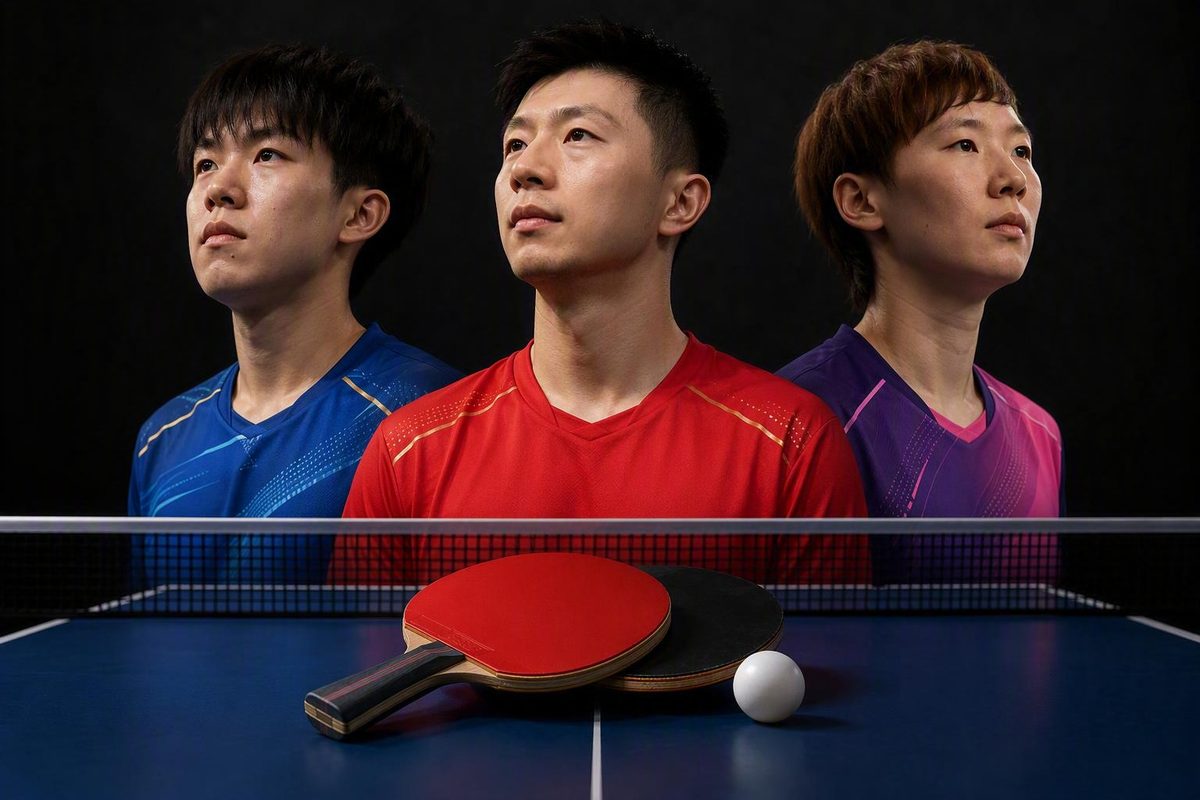
ITTF Week 38 (Sept 14, 2026) puts Wang Chuqin and Wang Manyu at No. 1; Ma Long’s five Olympic golds anchor the men’s all-time case. How each claim is measured.
If “best” means the current world No. 1, the answer for ITTF 2026 Week 38 (dated September 14, 2026) is Wang Chuqin in men’s singles with 8,157 points and Wang Manyu in women’s singles with 9,115 points. If “best” means greatest career, Ma Long has the strongest documented men’s case: five Olympic gold medals, two of them in singles, plus three world singles titles. Those are two different questions, and a third one, who is strongest right now, is not settled by ranking points at all.
The Week 38 Singles Leaders
| Category | No. 1 | Points | Gap to No. 2 |
|---|---|---|---|
| Men’s singles | Wang Chuqin | 8,157 | +678 (Félix Lebrun, 7,479) |
| Women’s singles | Wang Manyu | 9,115 | +140 (Sun Yingsha, 8,975) |
Figures are from the official ITTF results and rankings portal for the Week 38 list. The gaps describe positions within each table; they do not measure the probability of one player beating another.
The four players are not on one leaderboard. Men’s singles and women’s singles are separate categories, so Wang Manyu’s 9,115 and Wang Chuqin’s 8,157 are not comparable. The ITTF also publishes men’s doubles, women’s doubles, mixed doubles, youth, team and para lists; the official ranking hub never names one universal No. 1 across the sport.
Rankings are time-stamped. A later week can have different leaders and totals, so check the current list before quoting one.
Pick the definition of “best” you mean; the supported answer appears below.
Which “best” do you mean?
Each definition uses different evidence and gets a different answer.
Men: Wang Chuqin · Women: Wang Manyu
| Category | No. 1 | Points | Gap to No. 2 |
|---|---|---|---|
| Men’s singles | Wang Chuqin | 8,157 | +678 (Félix Lebrun, 7,479) |
| Women’s singles | Wang Manyu | 9,115 | +140 (Sun Yingsha, 8,975) |
ITTF 2026 Week 38, dated September 14, 2026. Men’s and women’s totals sit on separate lists and cannot be compared with each other. The list changes weekly; check the current release before quoting it.
No single official answer
The world ranking is a tournament-points table, not a win-probability estimate. Use recent results, head-to-head records in context, and a validated predictive rating if one is available. The current No. 1 is a reasonable starting guess, not proof.
Fix the period first, then count
Set the interval before looking at results (for example the previous six months), then weigh wins by event tier and opponent quality. A player can have the best recent run without leading the ranking, because ranking totals include older results that have not yet expired.
Men: Ma Long is the leading candidate
| Achievement (through Tokyo 2020) | Count |
|---|---|
| Olympic gold medals, all events | 5 |
| Olympic men’s singles titles | 2 |
| World singles championships | 3 |
| Defended Olympic singles title | First man |
The greatest women’s player is a separate comparison; this tool does not name one because the article carries no comparable evidence for it.
Sources: ITTF results and rankings portal, 2026 Week 38 list; ITTF Tokyo 2020 records recap (August 2021). Rankings change weekly.
Four Questions Hiding Behind One Word
Most arguments about the best table tennis player are two people answering different questions. One means the top-ranked player, another the player most likely to win today, a third the greatest career.
| Meaning of best | Evidence to use | What it establishes |
|---|---|---|
| Current ranking leader | Latest category-specific ITTF list | Who leads the points table for a stated week |
| Strongest current player | Recent results, head-to-head, a predictive rating if available | An estimate of playing strength or matchup odds |
| Best recent form | Results over a defined period, weighted by event and opponent | Who has produced the strongest recent run |
| Greatest career | Major singles titles, peak dominance, consistency, longevity | An evidence-based but evaluative all-time judgment |
A defensible claim states four things: the discipline (singles, doubles, mixed, team), the category (men’s, women’s, youth, para), the time period (a ranking week, a season, a career) and the measurement (ranking points, match results, a predictive rating, a title count).
“Wang Chuqin was the men’s singles No. 1 in Week 38” meets all four and is verifiable. “Wang Chuqin is the strongest player alive” drops the week and the method and needs different evidence. A player can have the best results over a defined recent window without leading the ranking, because the ranking also counts older results.
Why the World No. 1 Is Not Always the Strongest Player
The ITTF world ranking is a tournament-points table. It summarizes eligible competition results under ranking rules; it does not forecast the next match. A predictive rating does the opposite job, estimating relative strength or win probability from match outcomes.
Neither is defective. A points ranking orders players by recognized results within a category. It just answers a narrower question than “Who would beat everyone else this week?”
The mechanics that drive the table:
- Event tier sets how many points are available.
- Finishing position sets how many of those points a player earns.
- Only selected eligible results count toward the total.
- Results expire as the ranking window advances.
The exact counted-result limits, windows and exceptions have changed over the years. Rules introduced for 2018, and the separate youth regulations, are not the complete senior rules for 2026.
These rules produce outcomes that look odd until you see the arithmetic. A player can fall without losing a match when an older high-value result expires while a rival adds points. A player can win a smaller event and barely move, because the result carries few points or does not displace anything already counting. Our explainer on how table tennis world rankings work walks through the mechanics.
So a ranking and a predictive rating can disagree without either being wrong, and head-to-head records need context (period, event importance, opponent form) before they settle anything. Ranking points alone cannot answer the strongest-current-player question.
Ma Long Has the Strongest Documented Men’s All-Time Case
Through Tokyo 2020, Ma Long had won five Olympic gold medals, including two men’s singles titles, and three world singles championships. He was also the first man to defend an Olympic table tennis singles title, per the ITTF’s Tokyo 2020 records recap.
Each element carries weight on its own:
- Two Olympic singles titles show repeated success in the sport’s highest-pressure singles event.
- Three world singles titles show sustained achievement at the other premier championship.
- Five Olympic golds across events make him the most decorated Olympic table tennis player, as the ITTF recap described him.
- Defending the men’s singles title had never been done in Olympic table tennis.
The ITTF’s 2021 recap used celebratory language suggesting Tokyo had settled the greatest-ever debate. The records are fact; the “debate over” framing is editorial judgment, not a formal cross-era ITTF ranking. “Ma Long is the leading candidate for greatest men’s player ever” is the defensible version.
His record says nothing about the greatest women’s player. That is a separate question that needs a comparison of women’s careers on the same criteria, and the evidence here does not cover it. A single universal “greatest player” across men’s and women’s competition, all disciplines and all eras would need a comparison nobody has made on stated criteria.
How to Check Any Best-Player Claim
When a headline, commentator or post names the best table tennis player, run it through these checks:
- Confirm the category. Men’s singles, women’s singles, doubles, youth, para, or a whole career?
- Check the effective date. A ranking without a week is incomplete; standings change every release.
- Separate rankings from ratings. A tournament-points table and a predictive strength rating answer different questions.
- Read recent results with context. Period covered, opponent quality and event importance matter more than a raw win count.
- Compare major titles by type. For career claims, keep singles championships distinct from team and doubles medals.
- Weigh peak against longevity. A brilliant short peak and sustained excellence over many seasons are different forms of greatness; say which you are rewarding.
Never compare raw points across men’s singles, women’s singles, doubles or youth lists. Wang Manyu’s 9,115 and Wang Chuqin’s 8,157 do not make her “958 points better”; each total only locates a player within its own table.
Start at the official ITTF ranking hub for the newest lists, then use player profiles for ranking history, match records, win rates and head-to-head context. For current strength or recent form, fix the window first (the previous six months, say) rather than choosing it after seeing the results.
For an all-time claim, state the weighting. If Olympic singles titles are the primary criterion, say so. If world titles, peak dominance and longevity count equally, make that explicit. A visible method does not remove judgment, but it makes the conclusion testable.
The reliable formulation is “Player X is the No. 1-ranked men’s or women’s singles player for Week Y.” Turning that dated, category-specific fact into “Player X is the best in the world” adds a claim the ranking does not support.