
Why Wang Nan Holds Table Tennis’s Youngest Grand Slam Record
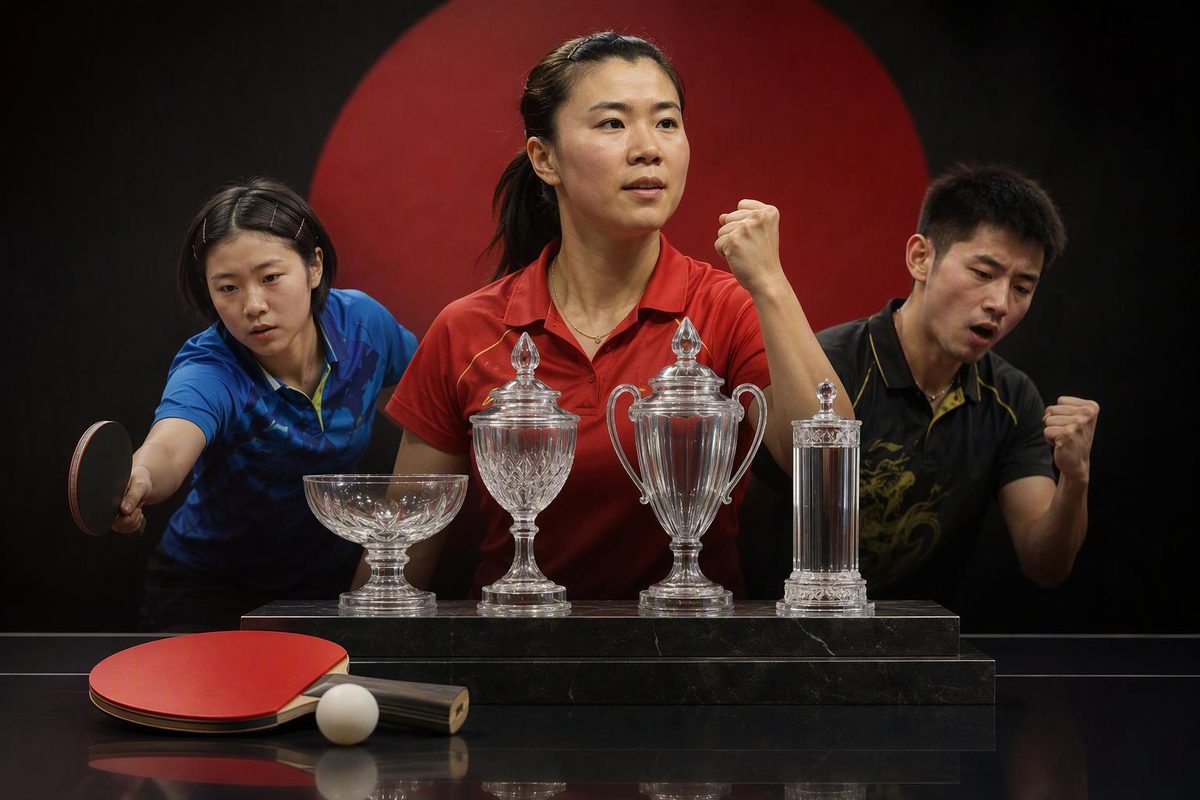
Compare Wang Nan’s career Grand Slam age with Sora Matsushima’s Grand Smash record and Zhang Jike’s fastest completion, using dated results and sources.
Wang Nan is the youngest player to complete table tennis’s traditional career Grand Slam. She completed the set with Olympic women’s singles gold in Sydney on 24 September 2000, aged 21 years, 11 months and 1 day. That exact age comes from her documented birth date of 23 October 1978 and the dated Olympic final result. She was still 21, not yet 22.
That answer applies to the career achievement: winning Olympic, World Championships and World Cup singles titles. It does not mean the youngest winner of a WTT Grand Smash tournament. Sora Matsushima holds the Grand Smash men’s singles age record reported below, while Zhang Jike’s 445-day achievement concerns the fastest career Grand Slam, not the youngest completion.
Choose the record you mean; the result separates age, tournament wins and completion time.
Which Record Are You Comparing?
Age and elapsed title-winning time are different measures.
Wang Nan
21 years, 11 months and 1 day
Completed the Olympic–World Championships–World Cup singles set on 24 September 2000.
Born 23 October 1978; she was still 21 at the Sydney final.
Record Evidence And Scope
Wang Nan: Career Grand Slam
First qualifying singles titles: 1997 World Cup in Shanghai; 1999 World Championships in Eindhoven; 2000 Olympic Games in Sydney.
Completion: 24 September 2000, beating Li Ju 3–2. Birth date: 23 October 1978. Age: 21 years, 11 months and 1 day.
Sources: ITTF career retrospective and World Cup history; China.org.cn birth record; Olympedia final result. China News Service's 2021 report describes the youngest women's winner as 22; the dated calculation gives 21.
Sora Matsushima: Grand Smash Men's Singles
2026 United States Smash: 19 years and 67 days. Beat Vladimir Sidorenko 4–2 on 5 July 2026.
Previous record: Lin Shidong, China Smash 2024, at 19 years and 171 days.
Sources: WTT United States Smash report and Olympics.com match report. WTT's claim concerns Grand Smash men's singles, not career Grand Slam completion.
Zhang Jike: Fastest Career Grand Slam
445 days across the 2011 World Championships, 2011 World Cup and London 2012 Olympic singles title.
Exact completion age in the supplied evidence: —.
Source: ITTF Olympic history report. Duration runs from the first qualifying title to completion, not from birth.
Sources: ITTF definition and record reports, WTT, Olympedia, China.org.cn, China News Service and Olympics.com; linked in the article.
A Career Grand Slam Requires Three Different Singles Titles
The ITTF’s 2016 Olympic media guide defines a table tennis career Grand Slam as winning singles titles at the Olympic Games, World Table Tennis Championships and ITTF World Cup. A player must have all three. Winning one of those competitions repeatedly does not replace a missing title at another.
The word career matters. The three victories do not need to happen in one calendar year, and the player does not need to hold all three titles simultaneously. The question is whether their career results include a singles victory at each required competition.
Doubles and team results do not count toward this particular set. An Olympic doubles champion who has World Championships and World Cup singles titles would still need Olympic singles gold. A medal total, however impressive, therefore cannot establish a singles Grand Slam on its own.
| Required Competition | Result That Counts | Result That Does Not Substitute |
|---|---|---|
| Olympic Games | Singles gold | Doubles or team gold |
| World Championships | Singles title | Doubles or team title |
| ITTF World Cup | Singles title | A title at another competition |
For an age record, the decisive event is the last missing singles title. A player’s age at their first major victory describes the beginning of the sequence, not the age at which they became a Grand Slam winner.
This also explains why “youngest champion” needs a competition attached to it. Being the youngest winner of one tournament and being the youngest player to finish a three-competition career set are different claims. The former can be established by one title result; the latter requires the player’s earlier qualifying titles as well as the completion result.
Wang Nan Completed The Set With Sydney Singles Gold
Wang Nan’s first qualifying victory was the 1997 ITTF Women’s World Cup in Shanghai. She added the 1999 World Championships singles title in Eindhoven, then completed the set at the 2000 Sydney Olympics.
| Required Singles Title | First Win | Position In The Sequence |
|---|---|---|
| ITTF Women’s World Cup | 1997, Shanghai | First qualifying title |
| World Championships | 1999, Eindhoven | Second qualifying title |
| Olympic Games | 2000, Sydney | Grand Slam completion |
The ITTF’s career retrospective records those three wins. Its World Cup history also confirms Shanghai as the location of her first victory.
Wang also won the 1998 World Cup, but that victory repeated a competition already present in her career record. It added another World Cup title without filling either of the remaining Grand Slam requirements. For this record, the relevant World Cup result is therefore her first win in 1997.
After Eindhoven, Olympic singles gold was the missing piece. In the Sydney singles final, Wang beat Li Ju 3–2. That final—not an earlier round, her arrival at the Games or the end of the Olympic tournament as a whole—is the result used to date her completion.
Wang and Li Ju also won Olympic doubles gold. That was a separate achievement and cannot be substituted for the singles result in this calculation. Even when the same players feature in both events, the event category determines whether a title belongs in the Grand Slam record.
The sequence makes the age claim auditable. The World Cup and World Championships wins establish that Wang already held the other two required singles titles; the Sydney final establishes when she acquired the third. Her birth date then supplies the age on that specific day.
Wang Was 21, Not Yet 22, On The Completion Date
Wang was born on 23 October 1978 and won the Olympic singles final on 24 September 2000. Her birthday that year had not yet occurred. The calendar interval between those dates is 21 years, 11 months and 1 day.
The calculation uses completed calendar years, then months and days. It does not subtract the birth year from the competition year and treat the answer as an exact age. That shortcut would produce 22 because it ignores the position of the birthday within the year.
You may nevertheless see Wang described as 22 when she completed the Grand Slam. A 2021 report carried by China News Service uses that age while identifying her as the youngest women’s Grand Slam winner. The dated birth record and Olympic final support the more precise statement: she completed it while still 21.
There is also a distinction between what that report explicitly says and the broader record being discussed here. Its description concerns the women’s Grand Slam record. It should not be presented as though that wording itself supplies a complete comparison of every male and female Grand Slam winner.
For readers checking a quoted age, the dates are more useful than a rounded age label. “At 21” and “21 years, 11 months and 1 day” are compatible statements. “At 22” does not describe her completed chronological age on the Sydney final date.
Exact completion dates also prevent a different mistake: assigning an age from the championship year alone. A competition’s year identifies the season, but an age record is attached to the day the qualifying title was won. Wang’s record can be stated precisely because both the birth date and the final date are available.
Sora Matsushima’s Record Is For A WTT Grand Smash Tournament
A WTT Grand Smash is a tournament, not shorthand for the Olympic–World Championships–World Cup career set. The similar names are the main reason two different youngest-winner claims can appear to conflict.
Sora Matsushima won the 2026 United States Smash at 19 years and 67 days. WTT’s official tournament report identifies him as the youngest Grand Smash men’s singles champion at that time. He took the record from Lin Shidong, who won China Smash 2024 at 19 years and 171 days.
Olympics.com’s match report confirms that Matsushima beat Vladimir Sidorenko 4–2 on 5 July 2026. Those details identify the title and final behind the age claim; they do not establish a completed career Grand Slam.
Matsushima’s title-winning age is younger than Wang’s Grand Slam completion age. That comparison is numerically straightforward but does not make the records interchangeable. One age belongs to a single WTT tournament victory, while the other belongs to the completion of three specified career titles.
The scope of WTT’s claim must also remain intact: it is the Grand Smash men’s singles record. It is not a claim about every Grand Smash event category, every table tennis tournament or the youngest champion anywhere in the sport.
When referring to Matsushima, “youngest Grand Smash men’s singles champion” preserves the competition and category. Calling him the “youngest Grand Slam winner” would change the achievement being described and would not be supported by that tournament report.
Likewise, Lin Shidong’s earlier record belongs in the Grand Smash comparison, not Wang Nan’s career Grand Slam sequence. His China Smash victory explains which tournament-age mark Matsushima surpassed. It does not supply one of the three traditional career Grand Slam requirements.
Zhang Jike’s 445 Days Measure Speed Rather Than Age
Zhang Jike won the 2011 World Championships, the 2011 World Cup and Olympic singles gold at London 2012 within 445 days. The ITTF identifies that as the fastest career Grand Slam.
This is the same three-title career achievement as Wang’s, but the measurement is different. The fastest-completion clock starts with the first qualifying title and ends with the title that completes the set. The youngest-completion calculation starts with the player’s birth date and ends with that completing title.
In plain terms, youngest completion age equals completion date minus birth date; completion duration equals completion date minus first qualifying title date.
A short title-winning sequence does not necessarily imply a young completion age. A player could begin the sequence later in their career and complete it quickly. Conversely, a player could win their first qualifying title early, take longer to acquire the other two and still finish at a younger age.
The supplied record for Zhang is a duration of 445 days, not an exact age at completion. An exact completion age for him is not provided by the material used here, so it should not be filled into an age comparison by guesswork. The documented claim answers “fastest,” while Wang’s dated calculation answers “youngest.”
World-ranking position and ranking-points totals measure something else again. Neither an age record nor a career-title completion time is a ranking score. The distinction is explained in how table tennis world rankings work.
Compare The Records Without Changing Their Scope
The three headline records can be kept separate by retaining the achievement, measurement and event category in each description.
| Record | Player | Recorded Measure |
|---|---|---|
| Youngest career Grand Slam completion | Wang Nan | 21 years, 11 months, 1 day |
| Youngest Grand Smash men’s singles champion | Sora Matsushima | 19 years, 67 days |
| Fastest career Grand Slam completion | Zhang Jike | 445 days |
For Wang, the supporting chain is a birth date, two earlier qualifying singles titles and the Olympic singles final that completed the set. For Matsushima, it is a WTT tournament result and the tournament organiser’s age-record statement. For Zhang, it is the elapsed interval across the three qualifying career titles.
Those chains answer different questions. A smaller age in the Grand Smash row cannot replace the career Grand Slam answer, and a smaller number expressed in days cannot be compared directly with an age expressed in years. The measurement must stay attached to the achievement it describes.
For the traditional table tennis meaning of youngest Grand Slam winner, the answer is Wang Nan, completing the set at Sydney 2000 while still 21. Use Matsushima’s name for the WTT Grand Smash men’s singles age record and Zhang Jike’s for the fastest career completion.