
The Results and Expiries Behind Wang Manyu’s No. 1 Ranking
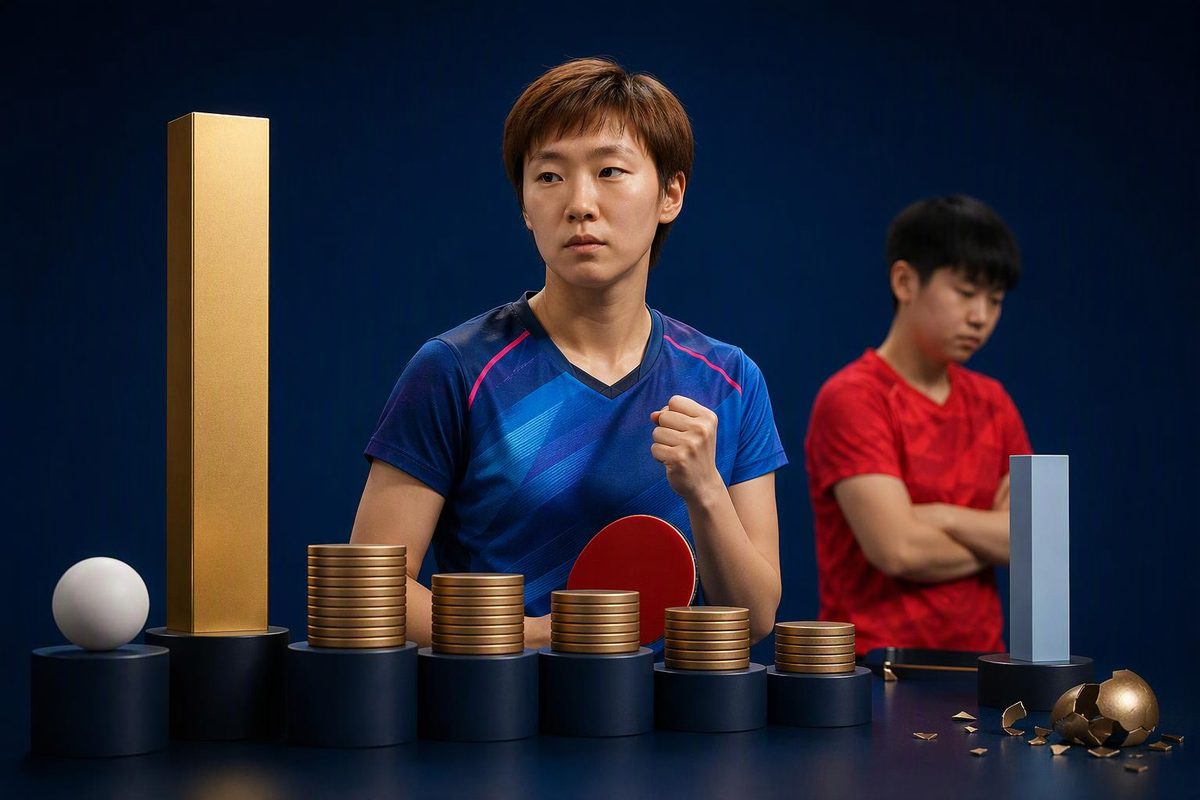
See Wang Manyu’s eight counted results, her 140-point advantage over Sun Yingsha, and how expiring China Smash points could change the next ranking.
Wang Manyu is women’s singles world No. 1 because her counted ITTF ranking results total 9,115 points—140 more than Sun Yingsha’s 8,975. Those are the figures in the Week 40 list, dated September 28, 2026, also shown on the official WTT rankings page when checked on October 3, 2026.
Her rise combined major results of her own, particularly the Europe Smash title, with older points expiring from Sun’s record without equivalent new results replacing them. The ranking is a sum of eligible results, not a vote on who plays better or a reward for Wang’s lifetime medal collection. The date matters: a 140-point lead on this list is not a guarantee of the same order after the next set of expiries.
Enter replacement points to test the October 5 expiry, holding each player’s other seven counted results unchanged.
China Smash Expiry Comparison
Wang Manyu: 9,115 · Sun Yingsha: 8,975
Hypothetical Result
Unknown — enter both replacement contributions.
Wang: — · Sun: —
Other seven counted results are held unchanged. This is not a next-ranking forecast.
| Player | Expiring | Retained Total |
|---|---|---|
| Wang | 2,000 | 7,115 |
| Sun | 1,400 | 7,575 |
Retained totals subtract only the China Smash 2025 points expiring October 5, 2026.
Assumptions And Threshold
Wang’s hypothetical lead = −460 + her replacement points − Sun’s replacement points. She needs a replacement contribution more than 460 points higher than Sun’s to lead under these assumptions.
Exactly 460 gives equal calculated totals, not an official tie-break decision. Enter 0 only to test no replacement contribution; blank means unknown. Other expiries, newly counted results, eligibility restrictions and penalties are not modelled.
Sources: ITTF Week 40 record and 2026 ranking regulations; retained totals and threshold are arithmetic, not forecasts.
Eight Counted Results Give Wang 9,115 Points
Under the ITTF regulations updated January 27, 2026, rankings generally add the eight highest-point, non-expired results, subject to eligibility restrictions and penalty rules. Points normally remain valid for one year, with specified exceptions for continental events.
That makes the relevant question which results are currently counted, rather than how many tournaments a player has won across her career. A title outside its validity period cannot keep supporting the total simply because it was prestigious. Equally, a result that is still valid does not necessarily increase the total if it is outside the player’s counted set.
Wang’s Week 40 total can be reconstructed from the individual contributions in her official women’s singles record:
| Counted Result | Finish Or Contribution | Points |
|---|---|---|
| China Smash 2025 | Champion | 2,000 |
| Europe Smash–Sweden 2026 | Champion | 2,000 |
| WTT Finals Hong Kong 2025 | Champion | 1,500 |
| Singapore Smash 2026 | Runner-up | 1,400 |
| World Cup Macao 2026 | Runner-up | 1,050 |
| World Team Championships London 2026 | Individual team allocation | 417 |
| Mixed Team World Cup Chengdu 2025 | Individual team allocation | 398 |
| Asian Cup Haikou 2026 | Runner-up | 350 |
| Total | 9,115 |
The two Smash titles alone supply 4,000 points. Adding the Finals title brings those three wins to 5,500, more than half her total. Those are the largest building blocks of her position, but they do not explain the entire lead.
Her Singapore Smash and World Cup runner-up finishes contribute another 2,450 points. The two team allocations and Asian Cup runner-up finish supply the remaining 1,165. All eight rows matter when the margin over Sun is only 140 points: the ranking does not stop counting once a player’s headline titles have been identified.
The table also shows why counting trophies is an inadequate shortcut. Wang’s total includes wins, runner-up finishes and individual allocations from team competitions. Those contributions have different values. To reproduce the ranking, use the points attached to each eligible result, not a count of first-place finishes.
Team Allocations Count, But Doubles Titles Do Not
The two team rows need a distinction. Players do not each receive the entire team award. The regulations allocate points according to their share of the team’s wins, or games won in game-based competitions.
Wang’s record lists 417 points from China’s winning World Team Championships result in London and 398 points from China’s winning Mixed Team World Cup result in Chengdu. Those are her individual allocations in the singles ranking record, not the full value awarded to the team.
Together, the two rows contribute 815 points. Leaving them out would fail to reproduce her published total. Adding an entire team award instead would also misstate her individual points. The correct figures for this calculation are the allocations shown against her name.
Her doubles titles are not added to this women’s singles total. A result can be part of her broader competitive record without belonging in the calculation that determines her singles position. Keeping those categories separate is necessary to explain why the official total is 9,115 rather than an informal sum of everything she has won.
Europe Smash Helped Her Overtake Sun Yingsha
The ITTF’s September 15 announcement confirmed Wang’s first career appearance at No. 1, ending Sun’s 217-week reign. It highlighted Wang’s Europe Smash victory in Malmö, where she defeated Wang Yidi in the final.
Europe Smash is worth 2,000 points in Wang’s Week 40 record, making it one of her two largest counted contributions. That explains why it is central to the story of her rise. It does not mean that her ranking can be understood by looking at that final alone: the other seven counted results still determine the total alongside it.
The timing of the takeover also depended on Sun’s record. In its explanation of the ranking change, WTT reported that Sun had not played internationally since winning the United States Smash in July. She missed Champions events in Yokohama and Macao, as well as Europe Smash. WTT attributed her diminishing lead to points expiring from corresponding stops on the previous year’s calendar.
That is a narrower claim than saying absence automatically deducts points. The explanation here is that older results ceased to be eligible and Sun did not have equivalent new results replacing them. The ranking total responds to the eligible record; it does not require a new defeat before it can fall.
The announcement of Wang’s first No. 1 ranking and the Week 40 figures are also different reference points. The announcement establishes when she first reached the position and describes the takeover. The later dated list establishes the 9,115–8,975 comparison used here. The 140-point margin should not be silently applied to every week of her reign.
Expiry Can Lower A Total Without A New Defeat
A rolling ranking can change even when a player has not just lost a match. Once an older result expires, it stops being eligible. Another available result may enter the counted set, but that replacement can be worth fewer points than the result it replaces.
The effect therefore depends on both sides of the change. Removing a large result reduces the total; bringing in another eligible result offsets some or all of that reduction. A rival can simultaneously improve her own counted set with a stronger new result. Those movements together can change the order at the top.
This is why the gross points value of a new result and its net effect on a player’s total are not always the same. If a result enters an already full counted set, the displaced contribution matters too. For the broader calculation, see how table tennis world rankings work.
The available explanation supports the mechanism behind Wang’s takeover: her major results strengthened her record while expiry weakened Sun’s advantage. It does not supply a complete before-and-after ledger for every result at the exact moment of the switch. There is no basis here to invent a precise breakdown of how much of that earlier change came from each expiry or replacement.
Sun’s Major Titles Still Leave Her 140 Points Behind
Sun still had substantial wins in her Week 40 record. Singapore Smash and United States Smash were worth 2,000 points each, and her World Cup title added 1,500. Those three wins total 5,500 points, the same contribution as Wang’s two counted Smash titles and Finals title.
That comparison is useful because it rules out a simplistic explanation: Wang is not ahead merely because those three headline wins contribute more than Sun’s three headline wins. They contribute the same amount in the selected groups. The rest of each counted set supplies the difference.
Subtracting 5,500 from the published totals leaves 3,615 points for Wang and 3,475 points for Sun. The difference remains 140. These are arithmetic subtotals, not separate ranking categories, but they show why comparing only a few major trophies misses the deciding margin.
The full eight-result breakdown provided here is Wang’s. Sun’s three cited title values and published total do not, by themselves, identify every other counted contribution. They are enough to illustrate the comparison without pretending to reconstruct rows that have not been supplied.
No. 1 depends on the complete eligible total. Selecting one tournament that Sun won, or one final that Wang won, cannot override the published sum.
October 5 Expiry Creates A 460-Point Replacement Test
The Week 40 record lists Wang’s 2,000 China Smash 2025 points and Sun’s 1,400 points from that event as expiring on October 5, 2026. Wang therefore has 600 more points attached to that particular expiring result than Sun does.
Removing only those two contributions would leave Wang with 7,115 points and Sun with 7,575. On that deliberately incomplete calculation, Sun would be ahead by 460 points. That is not a forecast of the next official ranking: it excludes replacements, newly counted results and any other changes.
The calculator isolates this one expiry. It retains each player’s other seven Week 40 contributions and lets you enter a hypothetical replacement contribution for the vacated slot. Its calculation is: Wang’s hypothetical lead equals −460 plus Wang’s replacement points minus Sun’s replacement points.
Under those assumptions, Wang needs a replacement contribution more than 460 points higher than Sun’s to remain ahead. A difference of exactly 460 makes their calculated totals equal; it does not establish how an official ranking would order an equal-points case. A smaller difference puts Sun ahead in this simplified comparison.
A blank input means the replacement is unknown, not zero. Entering zero explicitly tests a scenario with no replacement contribution for that player. The figures supplied here do not establish either player’s actual next replacement, so the tool does not prefill a prediction.
If another retained result expires, a new result displaces a different contribution, or another applicable adjustment changes the record, this single-slot calculation no longer reproduces the full ranking. The next official dated list is the evidence needed to confirm who actually holds No. 1.
World No. 1 Measures Results, Not A Match Prediction
Wang’s ranking establishes that she has the highest counted points total on the cited list. It does not establish a head-to-head win probability against Sun or settle an all-time “best player” argument. ITTF ranking points measure eligible competitive results rather than functioning as an Elo-style prediction rating.
For this question, the defensible verdict is specific: Wang leads because her eight counted contributions sum to 9,115, ahead of Sun’s 8,975. Her Europe Smash title helped build that position, and expiry on Sun’s record helped explain the takeover. With only 140 points separating them and unequal China Smash points due to expire, the ranking’s date is part of the answer—not a detail that can be omitted.