
The Regulation Table Size, Net Height, and Clearances
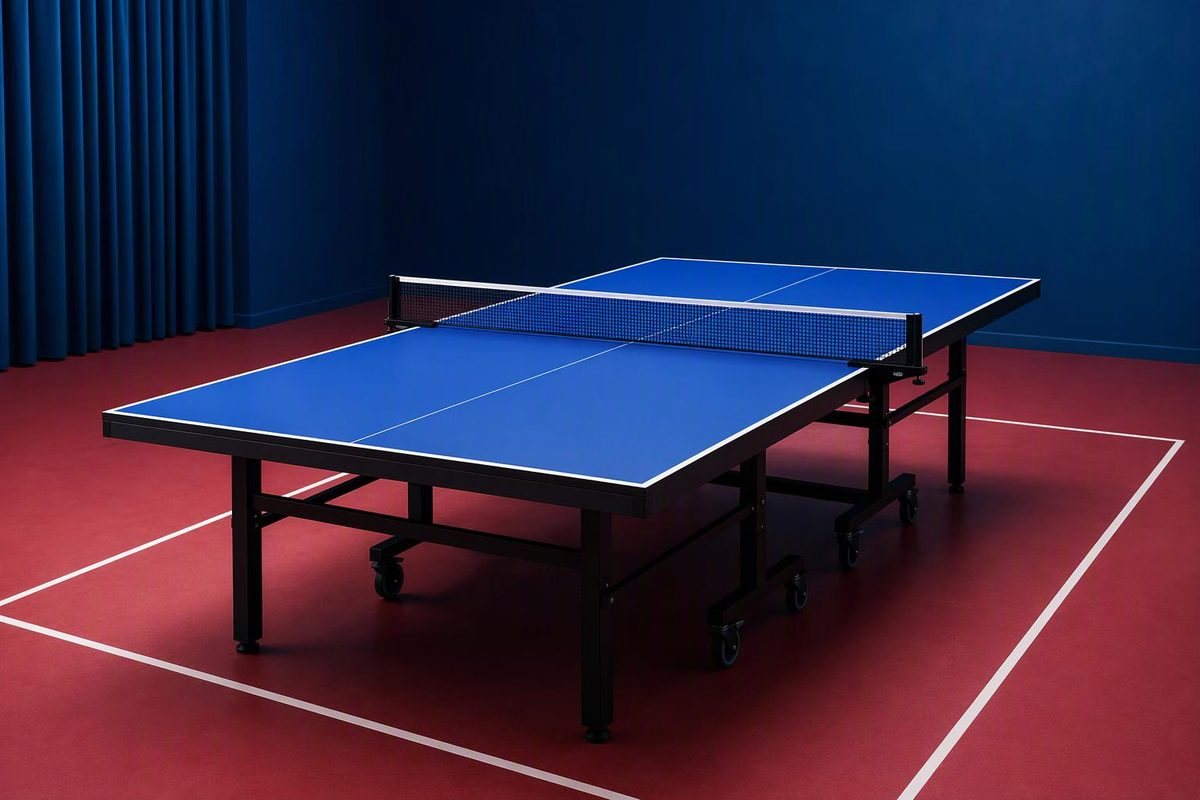
Check official table tennis table dimensions, net height, court markings, bounce rules and the room needed for home or competition play.
An official-size table tennis table is 2.74 m long, 1.525 m wide and 76 cm high. Those measurements apply to the upper playing surface—not the frame, legs, wheels or other hardware—and are commonly rounded to 9 × 5 feet.
Enter your room dimensions to check whether the playing surface or standard competition envelope fits.
Room Dimensions
This room meets the standard 14 × 7 × 5 m minimum playing-space envelope.
With the table centred: 5.63 m behind each end and 2.74 m beside each sideline.
Source: 2026 ITTF Laws 2.1 and Regulation 3.2.3.1. Clearances use the playing surface only; hardware may project beyond it.
Official Table Dimensions Are 2.74 × 1.525 Metres
The official dimensions come from Law 2.1 in the 2026 ITTF Statutes. The metric measurements are the figures to use when checking whether a table conforms to the Laws of Table Tennis.
| Measurement | Official metric size | Approximate imperial size |
|---|---|---|
| Length | 2.74 m | 9 ft |
| Width | 1.525 m | 5 ft |
| Height from floor | 76 cm | 2 ft 6 in |
| Net height | 15.25 cm | 6 in |
The familiar “9 × 5-foot” description is rounded imperial shorthand. It is useful when comparing recreational tables or planning a room, but it should not replace the metric dimensions when exact compliance matters.
The height is measured from the floor to the horizontal playing surface. A listing that gives only the table’s length and width does not establish that the surface is at the official 76 cm height.
Likewise, an assembled product’s overall footprint may be larger than 2.74 × 1.525 m. Net clamps, supporting posts, undercarriages and wheel assemblies can extend beyond the edges of the playing surface. Manufacturer specifications are needed if the available floor area is tight.
The Playing Surface Excludes the Table’s Vertical Sides
The regulation rectangle covers the upper surface on which the ball can bounce. The vertical sides of the tabletop are expressly excluded from the playing surface.
That distinction affects both measurements and play. The 2.74 m length and 1.525 m width should be measured across the top. Measuring the frame or wheelbase can produce a different result without establishing the size of the legal playing surface.
The table is divided by the net into two equal courts. Each court is 1.37 m long and 1.525 m wide. The net runs across the full width of the table, with its top edge 15.25 cm above the playing surface.
The outside limit of each net post is 15.25 cm beyond the corresponding sideline. The two outside post limits are therefore 1.83 m apart. A net assembly can consequently be wider than the tabletop even though the playing surface remains 1.525 m wide.
Singles and doubles use the same table dimensions. There is no larger regulation table for doubles and no smaller regulation table for singles.
Doubles Adds a 3 Millimetre Centre Line
For doubles, a 3 mm white centre line divides each court into right and left half-courts. It runs parallel to the sidelines.
This line changes the court markings, not the dimensions of the table or the position of the net. A full-size table remains 2.74 × 1.525 m for both forms of the game.
The centre line is relevant to the doubles service rule. Its presence does not divide the whole table into four separately sized tables; it marks two half-courts on each side of the net.
A table can therefore have the correct overall dimensions but still lack a required marking for doubles competition. Conversely, a recreational table with a centre line is not automatically compliant if its size, finish or bounce differs from the Laws.
Size Alone Does Not Make a Table Regulation-Compliant
Under ITTF Law 2.1, the playing surface must satisfy requirements beyond length, width and height. It must:
- be uniformly dark-coloured and matt;
- have a 2 cm white sideline along each long edge;
- have a 2 cm white end line along each short edge; and
- produce a uniform bounce of about 23 cm when a standard ball is dropped from 30 cm.
The white boundary lines are part of the playing surface. The sidelines follow the 2.74 m edges, while the end lines follow the 1.525 m edges.
The matt-finish requirement matters because a correctly sized glossy surface would not satisfy the stated finish provision. The colour must also be uniform rather than varying across the top.
The bounce rule tests the performance of the surface rather than prescribing one particular construction. A tabletop may be made from any material if it meets the uniform-bounce requirement.
These dimensions, markings, finish and bounce provisions are also reproduced in Table Tennis England’s July 2026 edition of the Laws.
The Laws specify a 40 mm ball for the bounce test and match play. The regulation table tennis ball size explains the measurement and the meaning of the 40+ marking.
The Laws Do Not Set a Mandatory Tabletop Thickness
There is no mandatory tabletop thickness in ITTF Law 2.1. The official test is the required uniform bounce, together with the specified dimensions, finish and markings.
Thickness can affect durability and playing characteristics, so it remains a useful product-comparison detail. It should not be presented as an official dimension when the cited law does not prescribe it.
This is why two products advertised as full-size can have different top thicknesses. Both may provide a 2.74 × 1.525 m surface at a height of 76 cm, but dimensions alone do not show whether either product meets the bounce requirement or holds the approval needed for a particular event.
Marketing terms such as “official size,” “tournament size” or “competition size” should therefore be checked against the actual measurements. The phrase describes size only if no further compliance evidence is supplied.
Measure the Top Rather Than the Undercarriage
To verify a table, measure the playing surface from one end line to the other and from one sideline to the other. The target measurements are 2.74 m by 1.525 m.
Measure the height vertically from the floor to the top of the playing surface. The target is 0.76 m. Do not stop at the frame below the tabletop, and do not include the net in the table-height measurement.
Measure the net separately from the playing surface to its top edge. Its specified height is 15.25 cm. The same figure describes how far the outside limit of each supporting post extends beyond its sideline.
If room fit is the concern, take a second set of measurements across the complete assembled product. The playing-surface dimensions cannot reveal whether a wheel, folded-table support or net clamp protrudes into a wall or walkway.
For a table sold unassembled, distinguish between package dimensions and assembled dimensions. Neither package size nor the frame’s footprint substitutes for the required playing-surface measurement.
A Competition Playing Space Is Much Larger Than the Table
Table size and playing-space size are separate rules. ITTF Regulation 3.2.3.1 gives a standard minimum playing-space envelope of 14 m long, 7 m wide and 5 m high.
That envelope is about the area available for play, not the dimensions of the table. The table remains 2.74 × 1.525 m within it.
The regulation permits smaller minimum playing spaces for two specified categories: 8 m by 6 m for wheelchair events and 10 m by 5 m for Masters events. The cited figures do not establish a reduced minimum for every other event or venue.
The standard competition envelope is also not a requirement for every home recreation room. A room can physically hold a full-size table while remaining much smaller than 14 × 7 × 5 m.
The calculator above treats the table as a 2.74 × 1.525 × 0.76 m envelope and checks both possible horizontal orientations. Its displayed end and side clearances assume the playing surface is centred in the room. They do not include any additional space needed for projecting hardware.
Home Clearance Depends on How the Table Will Be Used
For a home or club installation, begin with the 2.74 × 1.525 m playing-surface footprint. Then account for unobstructed space behind both end lines and beside both sidelines.
A room equal to the tabletop dimensions would contain the playing surface in a purely geometric sense, but it would provide no horizontal clearance around it. That is not the same as having usable playing room.
Players who move farther behind the table or cover more ground laterally need more clearance than players staying close during casual rallies. The draft source material does not provide one universal home-room minimum, so no single smaller figure should be represented as an official domestic standard.
Ceiling height can also matter even when it is well above the 76 cm tabletop. The ITTF’s 5 m figure belongs to the standard competition playing-space envelope; it does not establish a universal ceiling requirement for a home table.
Obstacles within the nominal room dimensions can reduce usable space. Columns, stored furniture and inward projections are not accounted for merely by measuring wall to wall. The relevant dimensions are the unobstructed length, width and height around the table.
Confirm Approval Separately From Official Size
When shopping, look for a playing surface measuring 2.74 × 1.525 m at a height of 0.76 m. Check that those figures describe the assembled playing surface rather than the shipping carton or frame.
If the table will be used for organized competition, verify the event’s applicable rules and the model’s current approval status. Correct dimensions alone do not demonstrate current approval, the prescribed surface finish or the required uniform bounce.
A concise specification check should cover the metric length, width and height; the 15.25 cm net height; the boundary and doubles markings; the matt, uniformly dark surface; and the stated playing-space rules for the event concerned. Tabletop thickness may still affect the buying decision, but it is not one of the mandatory dimensions stated in Law 2.1.