
What Is the Mass of a Ping-Pong Ball?
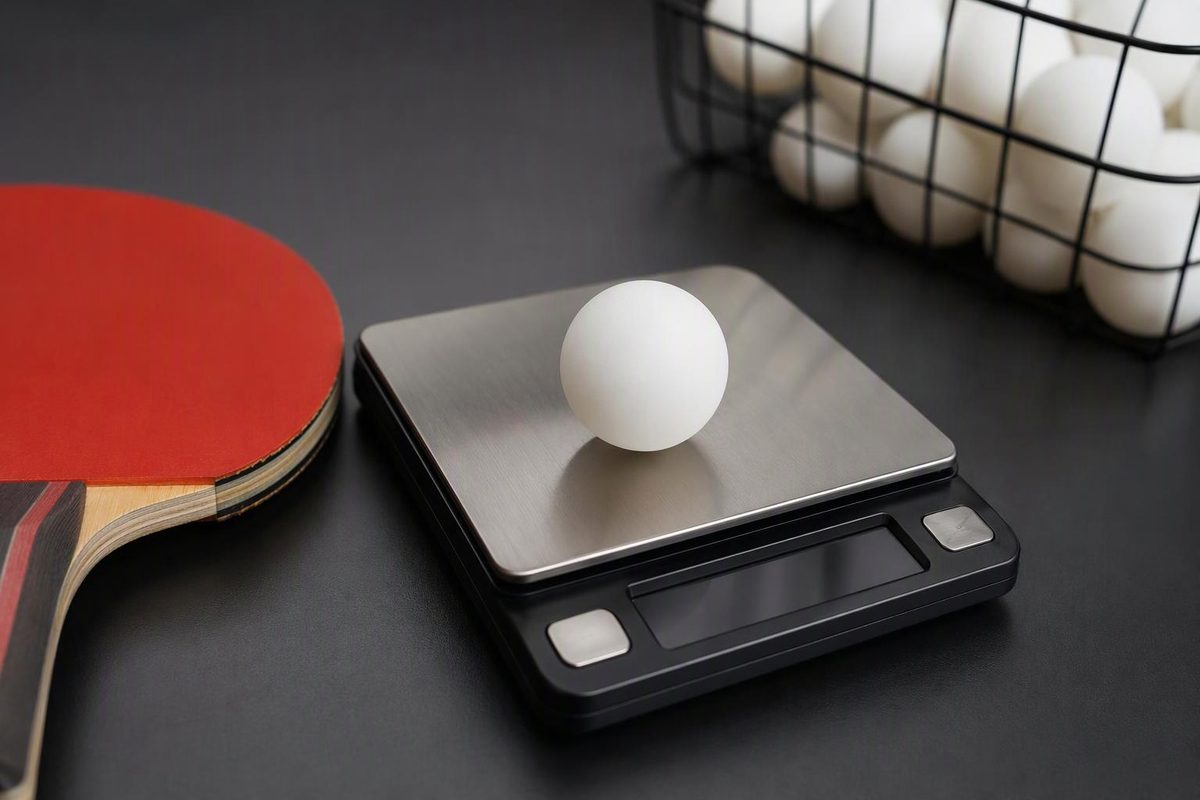
A regulation ping-pong ball has a mass of 2.7 g, or 0.0027 kg. Convert the units, distinguish mass from weight, and measure your own ball.
The regulation mass of a ping-pong ball is 2.7 grams, or 0.0027 kilograms. ITTF Law 2.3.2 states: “The ball shall weigh 2.7g.” The same ball must be spherical, 40 mm in diameter, and made of plastic with a white or orange matt finish. These specifications appear in the 2026 ITTF Laws of Table Tennis.
For a calculation using a standard table-tennis ball, use:
| Unit | Regulation mass |
|---|---|
| Grams (g) | 2.7 |
| Kilograms (kg) | 0.0027 |
| Milligrams (mg) | 2,700 |
These are equivalent values, not different ball specifications. If your formula uses SI units—for example, momentum in kg·m/s—use 0.0027 kg, not 2.7 kg.
Mass versus weight
In everyday table-tennis language, “weight” usually means the mass shown on a scale. In physics, weight is a force, measured in newtons, whereas mass is measured in kilograms. NIST’s guide to SI units explains this distinction and the everyday use of “weight” as a synonym for mass.
Using an approximate gravitational acceleration of 9.81 m/s² near Earth’s surface, the ball’s weight is:
Weight = mass × gravitational acceleration W = 0.0027 × 9.81 ≈ 0.0265 N
So 2.7 g answers the mass question; approximately 0.0265 N answers the gravitational-force question under that assumption.
If you need the mass of your actual ball
The 2.7 g figure is the regulation specification, not a measurement of every recreational ball sold. For an experiment, weigh the particular ball with a scale that can resolve hundredths of a gram.
If your scale is too coarse for one ball, weigh several together in a tared container and divide the net mass by the number of balls. For example, a measured total of 27.0 g for ten balls gives an average mass of 2.70 g; it does not establish each ball’s individual mass.
Mass and diameter are separate measurements. For the size specification, see the regulation diameter of a ping-pong ball.