
How to Turn Match Footage Into a Responsible Rating Range
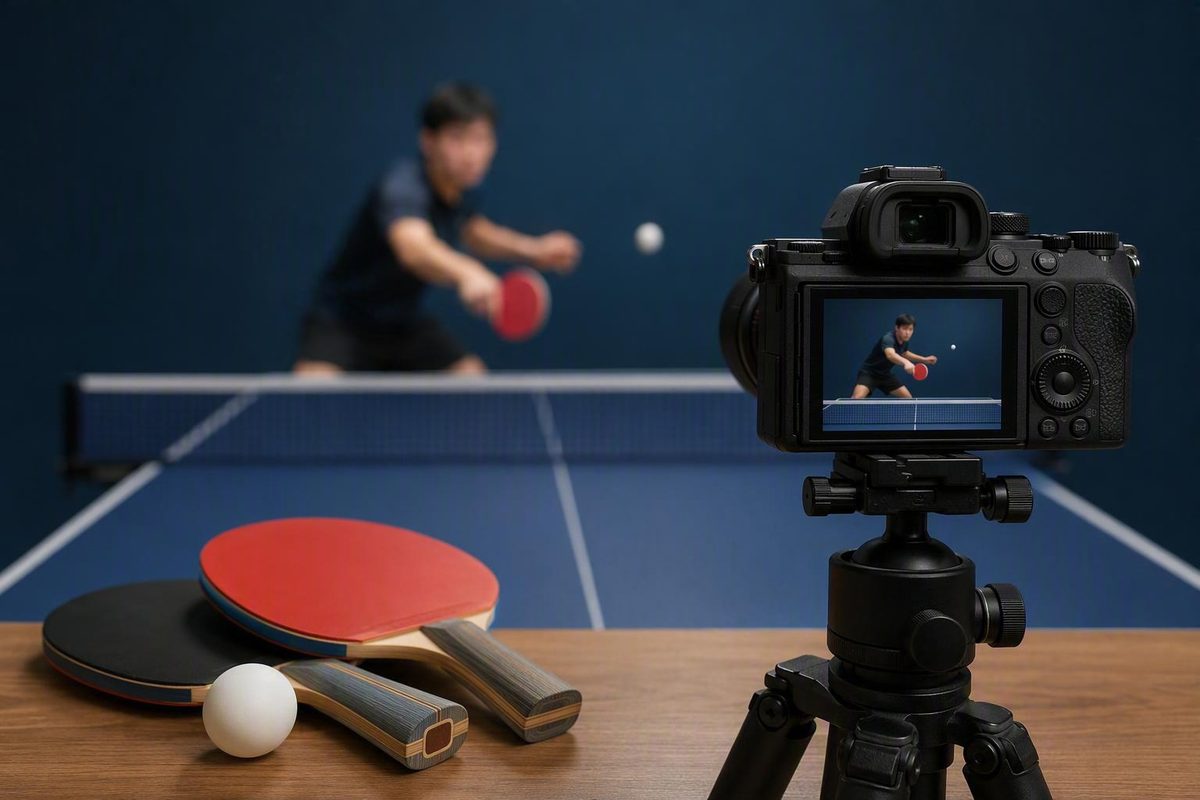
Use the footage to identify a broad band, state your confidence, explain the observations behind it, and list what the video does not show.
A complete match video can support a rough, unofficial USATT rating range, but it cannot establish an official rating. Use the footage to identify a broad band, state your confidence, explain the observations behind it, and list what the video does not show. Official USATT ratings depend primarily on competitive results and opponent ratings—not on how polished a player’s strokes appear on camera.
Related: How Table Tennis World Rankings Actually Work.
The short answer: estimate a range, not an exact rating
USATT’s rating process considers match results, opponents, rating-point exchanges, adjustments, and procedures for establishing initial ratings. Its calculation documentation provides no video-scoring rubric, no method for deriving an exact rating from technique footage, and no conversion to a Chinese amateur scale. Those limits make range estimation the responsible goal, as the official USATT ratings calculation explanation indicates.
A useful video assessment should report four fields:
- Estimated rating band: A broad range rather than a precise number.
- Confidence level: Low, moderate, or high, based on the quality and breadth of the evidence.
- Supporting observations: Recurring skills, decisions, and error patterns visible in the footage.
- Missing evidence: Important abilities or competitive conditions that cannot be judged.
The strength of the estimate depends on what the footage contains:
- Edited highlights: The weakest basis because unsuccessful points are usually missing.
- One complete match: Better because it reveals routine errors, serves, receives, and tactical patterns.
- Several complete matches: Better still because the reviewer can look for consistent behavior rather than one-match form.
- Complete matches with scores and known-rated opponents: The most interpretable evidence because visual observations can be compared with actual outcomes.
These tiers do not imply standard rating-band widths or validated accuracy margins. There is no supplied evidence showing that one full match should produce a range of a particular size or that several matches guarantee accuracy within a set number of points.
Use footage that shows the points players usually leave out
The most useful submission is not a montage of the player’s best forehands. It is stable, continuous footage showing what happens throughout competitive games, including awkward receives, missed openings, passive decisions, and ordinary rallies.
Use this submission checklist:
- Full, unedited games
- Visible score context, whether on screen or provided separately
- Both players kept in frame
- A camera angle that makes ball flight reasonably clear
- Enough court coverage to show footwork and recovery
- All serves and receives
- Routine rallies as well as outstanding points
- Errors, edge balls, nets, and interrupted points
- Time between points
- Final match result and individual game scores
- Footage against multiple opponents, when available
- Each opponent’s current or recent USATT rating, if known
Identify the player being assessed by shirt color, initial court side, and relevant timestamps. This prevents the reviewer from analyzing the wrong participant, particularly after the players change ends.
Competitive games are more informative than drills. A highlight reel creates a similar problem: it selects successful attacks while concealing missed receives, failed openings, rushed shot choices, and points lost before a rally develops.
These are editorial best practices for making footage interpretable.
A no-formula video review worksheet
Review the match point by point before choosing a rating band. Record recurring evidence rather than relying on the most memorable rally.
| Review area | Observed evidence | Recurring weakness | Coverage |
|---|---|---|---|
| Serve quality | Representative / limited / not visible | ||
| Receive quality | Representative / limited / not visible | ||
| Consistency and unforced errors | Representative / limited / not visible | ||
| Handling spin and pace | Representative / limited / not visible | ||
| Opening against underspin | Representative / limited / not visible | ||
| Footwork and recovery | Representative / limited / not visible | ||
| Positioning | Representative / limited / not visible | ||
| Placement and shot selection | Representative / limited / not visible | ||
| Tactical adaptation | Representative / limited / not visible | ||
| Anticipation | Representative / limited / not visible | ||
| Execution under pressure | Representative / limited / not visible |
Give particular attention to serve-receive exchanges, repeated error patterns, handling of underspin, and tactical choices. One spectacular counterloop may demonstrate technical potential, but it says less about likely tournament performance than the ability to receive repeatedly, open safely, choose appropriate shots, and avoid preventable errors.
After completing the worksheet, separate three judgments:
- Visible technical execution: Stroke production, movement, control, and other qualities that can actually be observed.
- Tactical maturity: Placement, variation, point construction, adaptation, and shot selection.
- Likely tournament performance: How reliably those skills appear under score pressure and against different opponents.
Do not claim to see spin or contact quality when the recording cannot show it.
The worksheet organizes human judgment. It is not a validated conversion formula, and its rows should not be assigned invented numerical weights.
Match the observations to broad USATT skill bands
The following descriptions are an unofficial coaching outline, not official USATT classifications. They summarize a self-rating scale adapted from one associated with coach Richard McAfee and reproduced by the Samson Dubina Table Tennis Academy. The page describes the scale as an outline that does not represent every player.
| Approximate band | Broad video characteristics |
|---|---|
| 701–900 | Dependable basic strokes and directional control at moderate pace and spin, with early attacking patterns beginning to appear. |
| 901–1100 | Dependable basic strokes with greater spin control, some ability to apply pressure through serve, and the capacity to return moderate-spin serves. |
| 1101–1300 | Emerging effective use of power and spin, improved handling of pace, some ability to change game plans, and greater pressure through serve and receive. |
| 1301–1500 | Better anticipation, an ability to handle medium-to-high pace and spin for short rallies, and several notably strong shots. |
| 1501–1700 | A broad advanced stroke and tactical range, strong footwork, and more dependable execution under stress. |
| Above 1700 | The outline generally associates this level with intensive training and regular participation in sanctioned tournaments. |
The table presented here starts at 701. If the footage appears to show a level below the lowest band, report that it falls outside the table’s covered ranges. Do not force the player into 701–900 or invent a lower-band description without supporting evidence.
Treat all of these descriptions as clusters, not gates. A player does not become a 1300-level competitor merely by displaying one strong opening loop, nor does one weak backhand automatically place someone below a band. Styles distribute skills differently: one player may win through serve and third-ball attacks, another through consistency, and another through disruption or defense.
The outline provides no validation data, error margin, or procedure for converting video observations into an official rating. Use it only to frame a tentative range after considering the full match.
Anchor the estimate to opponents and results
Results against rated opponents are closer to the evidence used by the USATT system than visual impressions are. For every match, record:
- The opponent’s rating at or near the time of the match
- The match result
- Individual game scores
- Whether the performance was representative of the player’s normal form
- Any relevant injury, inactivity, or unusual playing condition
A responsible low-confidence output might read:
Estimated 1100–1300, low confidence. Dependable basic strokes and moderate-spin handling are visible, but the opponent is unrated and receive quality under pressure is not established.
With several complete matches against known-rated opponents, confidence can increase because the reviewer can consider both visible behavior and actual outcomes. For example, repeated competitive results against players in a similar range are more informative than a single attractive game against an opponent of unknown strength.
Even then, a close result against one rated player does not prove equivalent playing strength.
Once the player enters sanctioned competition, compare the video estimate with the resulting official rating. Record the difference and examine why it occurred rather than treating the earlier estimate as confirmed.
State what could move the estimate up or down
Any estimate should identify the factors that could materially change it:
- Selective editing
- Unknown opponent strength
- Camera perspective
- Limited visibility of spin or contact
- Competition nerves
- Injury or fatigue
- Recent rapid improvement
- Inactivity
- A favorable or unfavorable style matchup
- A match that is not representative of normal form
Equipment and style complicate visual comparison. Conversely, a technically polished attacker may perform below the visual estimate because of receive errors, poor shot selection, low consistency, or weak execution under pressure.
One match can also understate a player. The opponent may prevent the player from using an important technique, or the footage may capture an especially unfavorable matchup. If a skill does not appear, mark it not visible rather than assuming the player lacks it.
Community discussions illustrate this uncertainty. In one forum attempt to estimate ratings from the same match footage, viewers differed substantially while emphasizing different cues, including serves, receives, spin, consistency, tactics, patience, and underspin handling. Those comments are informal opinions, not validated benchmarks. Claims that equivalent strength varies by US region should likewise be treated as anecdotal uncertainty, not as a quantifiable adjustment.
How an unofficial estimate differs from an initial USATT rating
A private video estimate is feedback. An initial USATT rating is part of an official tournament process based on results, opponents, rating calculations, adjustments, and procedures for unrated players.
USATT announced that tournament directors may submit estimated ratings for unrated entrants. Those estimates can be used when the system cannot derive a reasonable initial rating systematically, including certain cases in which the unrated player wins every match or loses every match. For tournaments beginning December 22, 2025, USATT also announced a minimum initial rating of 200 for a first-time tournament player in its rating-system process update.
That policy does not provide a video rubric, endorse video as the method for producing the submitted estimate, or establish that a tournament director must accept a player’s own video assessment.
The practical path is straightforward: use video to choose a tentative range, set expectations, or identify a suitable event level. Then rely on sanctioned match results for the official rating.
Do not convert the estimate directly to a Chinese amateur rating
Players do ask online communities to compare the systems; one example is a request for both USATT and Chinese ratings from playing footage. That interest does not establish a reliable conversion.
USATT’s official rating explanation provides no mapping to a Chinese amateur scale. A fixed conversion table would therefore be unsupported because the available evidence supplies neither a shared methodology nor a validated relationship between the systems.
Report the USATT estimate on its own terms. If another local scale must be discussed, describe the visible playing characteristics separately—such as serve-receive quality, consistency, opening ability, movement, and tactical maturity—rather than presenting a converted number as established fact.
Frequently asked questions
Can AI calculate a USATT rating from table tennis video?
AI cannot produce an official USATT rating from video. The cited research also does not establish a validated consumer tool for estimating unofficial USATT ranges from ordinary amateur footage.
Computer-vision research has explored table tennis skill assessment by reconstructing ball behavior, modeling context-dependent strokes, and considering positioning, opponent behavior, tactics, execution, and timing. One Kyoto University research preprint on video-based skill quantification used reconstructed professional-match data to predict relative and absolute player rankings.
That research does not establish a model that predicts USATT ratings, works accurately on ordinary amateur footage, or can replace tournament results. Its professional-data setting may not transfer to club recordings, unconventional equipment, difficult camera angles, or developing players.
The responsible output remains a range with a confidence level and a clear account of missing evidence—not an exact manufactured rating.